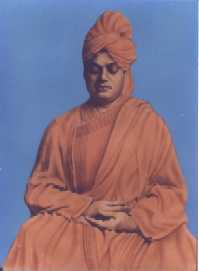
(1863-1902)
God, to Sri Ramakrishna, was a Fact and a Reality. He did not have to argue about God. He could affirm God. He was the peak of Indian Spiritual Culture. His vision was cosmic and his realization was all-embracing. Swami Vivekananda was his chief desciple, hid most beloved pupil, his greatest heir; his right interpreter and his most efficient executive.
Swami Vivekananda was born in Calcutta on January 12, 1863 on the holy day of Makara Sankranti. His father was Vishvanath Datta, a prominent lawyer of Calcutta and his mother was Bhuvaneswari Devi, a very cultured woman of aristocratic upbringing. The Dattas named the child Narendranath. The child was darling of everybody in and near the home. There was in him exuberance of energy and it was hard to tackle and contrlo him. He grew into an athlete and was proficient in all kinds of sports and games. He was good at studies as at play. He was a student with superlative talents. He had a very retentive memory and superior descriminative faculty. Even as boy he was meditative and a thinker. Many such excellences marked him out as a genius even at school and college.
A thinker that he was the question of God troubled Narendra. He went here and there in quest of God but in vain. At last the destiny brought him to Sri Ramakrishna. He asked the saint if he had seen God. Sri Ramakrishna Replied with a smile that not only had he seen God, but he could God to Narendra also. For nearly five years Narendra stayed with Sri Ramakrishna and was taught and trained by him. At the end of this short period of utmost intensity, Narendra had imbibed all the superhuman wisdom of Sri Ramakrishna Paramahamsa.
Sri Ramakrishna passed away in 1886, when Narendranath was not even twenty three. The responsibility of executing Sri Ramakrishna's mission fell on his young shoulder. He renounced home and became Swami Vivekananda and established a Math (a monastery) where he and his brother desciples could carry on austerities. He then wandered all over India, from Himalayas to Kanyakumari, by studying the motherland and understanding her problems at first hand and forming solutions for her regenaration.
In 1893 Swami Vivekananda left for America to attend the Parliament of Religions ] to be held at Chicago. He was formally not invited but was too luminous not to be let in. He had conquered by the he had finished his very first speech. Rising above the creeds and dogmas he spoke of harmony and universalism and his message came like the breath of life to the soffocating people. He toured America lecturing, teaching and helping people study Indian Philosophy. Then he went to England and Europe and became a bridge of understanding between the Orient and Occident.
In 1897 Swamiji returned to India. The whole nation rose like one man to honour him. The people saw in him a new Shankara who had risen to bring life and vigour to the motherland. The Swami reminded his countrymen of the Indian national ideal of renunciation, roused them to a sense of previlege in being Indians and showed them how spiritual culture was the secret of India's immortal existence.
The Swami's mission was both national and international. A lover of mankind, be strove to promote peace and human brotherhood on the spiritual foundation of the Vedantic Oneness of existence. A mystic of the highest order, Vivekananda had a direct and intuitive experience of Reality. He derived his ideas from that unfailing source of wisdom and often presented them in the soulstirring language of poetry.
In the course of a short life of thirty-nine years (1863-1902), of which only ten were devoted to public activities-and those, too, in the midst of acute physical suffering-Swami Vivekananda left for posterity his four classics: Jnana-Yoga, Bhakti-Yoga, Karma-Yoga, and Raja-Yoga, all of which are outstanding treatises on Hindu philosophy. In addition, he delivered innumerable lectures, wrote inspired letters in his own hand to his many friends and disciples, composed numerous poems, and acted as spiritual guide to the many seekers, who came to him for instruction. He also organized the Ramakrishna Order of monks, which is the most outstanding religious organization of modern India. It is devoted to the propagation of the Hindu spiritual culture not only in the Swami's native land, but also in America and in other parts of the world.
MESSAGE
He is an athiest who does not believe in himself. The old religion says that he was an athiest who does not believe in God. The new religion says that he is an athiest who does not believe in himself.
**************
After much austerity, I have understood this as real truth; God is present in every jiva (living being), there is no other God besides that. He who serves jiva serves God indeed.
**************
Each soul is potentially divine. The goal is to menifest the divinity within by controlling nature internal and external. Do this either by work or worship or psychic control or philosophy- by one or more or all of these and be free. This is the whole of religion. Doctrines or dogmas, or rituals or books, or temples or forms, are but secondary detail.
**************